Introduction
The monument of the Austro-Prussian War was unveiled in Jáchymov in 1899. It commemorated the townspeople and residents of nearby settlements who had fallen in the war of 1866. The sculptor Karl Wilfert the Elder from Cheb created the work, which was financed through a public collection organised by the local veterans’ association.
History
The war of 1866 significantly altered the balance of power in Central Europe. Among the fallen were citizens of Jáchymov and its surrounding communities. More than thirty years after the conflict, the local veterans’ association decided to honour them with a dignified monument. After the establishment of Czechoslovakia, however, the memorial came to be regarded as a symbol of the former Austro-Hungarian state. On the basis of legislation aimed at removing symbols of the Habsburg monarchy, it was dismantled in 1924. Today, the site is occupied by the memorial “New History”.
Description
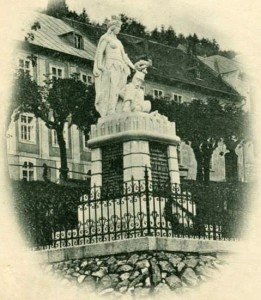
The monument consisted of a tall prismatic pedestal. Brownish-red marble plaques bearing the names of the fallen citizens of Jáchymov and the adjacent settlements were set into its sides.
Atop the pedestal stood an allegorical sculptural group representing Austria as a female figure and a dying soldier. The female figure leaned with her right hand on a shield bearing the Austrian eagle and held a laurel wreath in her left hand above the head of the dying soldier. The composition reflected the official monumental style typical of the late nineteenth century.
Restoration
The monument was not restored after its removal. Today, its appearance is known only from historical photographs and archival records. The current form of the site reflects later developments in the historical memory of the town.


