MEMORIAL TO STEPHAN SCHLICK IN JÁCHYMOV
Introduction
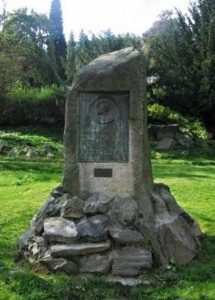
The personality of Count Stephan Schlick is inseparably connected with the foundation and development of Jáchymov in the first half of the sixteenth century. As a representative of the noble Schlick family, he stood at the origins of the town, whose prosperity was closely linked to silver mining and the minting of the Jáchymov thaler. In 1924, the municipal council therefore decided to honour the founder with a separate memorial in the public space.
History
The memorial was created according to a design by sculptor Michael Mörtel and executed by Ernest Hippmann. From the time of its unveiling, it represented an important symbol of the town’s identity and a reminder of its greatest economic flourishing.
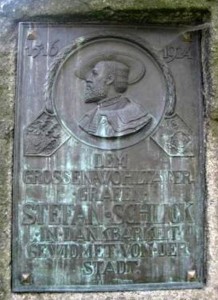
During the Second World War, the original commemorative plaque was removed from the monument and stored in a repository. This measure saved it from being melted down for wartime purposes, a fate that affected many metal memorial elements of that period. Thanks to this precaution, the original plaque survived.
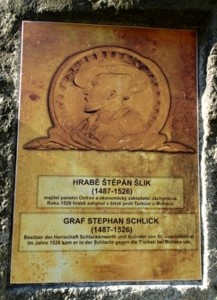
In 1993, the monument was restored and the original plaque reinstalled. A further intervention occurred in 2006, when the plaque was stolen, most likely to be sold as scrap metal. Today, the monument bears only a poorly executed plastic plaque that does not correspond to the original.
Description
The memorial is dedicated to Count Stephan Schlick as the founder of the town and symbolically refers to the period of its greatest prosperity connected with silver mining. Its architectural and sculptural design reflects the monument style of the 1920s and emphasises a dignified commemoration of the historical figure.
The original plaque bore a dedication highlighting Schlick’s merits in the foundation and development of the town. Although the current plastic plaque formally preserves the text and composition, it does not correspond to the original in either quality of workmanship or material.
Restoration
The restoration in 1993 returned the monument to a representative condition. The theft in 2006, however, once again reduced its authenticity. The present state represents a compromise between preserving the outward appearance and the reality of repeated losses caused by human actions.


