Grave of the Victims of the Second World War in Jáchymov
Introduction
Within the municipal cemetery in Jáchymov, among ordinary graves, lies a common burial site of victims of the Second World War. The remains of four Soviet prisoners of war, one Polish soldier and a man who died during a death march passing near the town at the end of the war are buried here. The prisoners of war were forced to work in the local mines under extremely harsh conditions.
History
After the war, the deceased were buried in the local cemetery. Their graves were cared for by the gravedigger Bohumil Malý, who was also a member of the local fire brigade. On 1 and 2 November 1948, members of the fire corps under his leadership, together with the commander of the Volunteer Fire Brigade of Jáchymov, constructed a new brick vault. Three coffins were purchased from the Municipal National Committee, into which the exhumed remains were placed and subsequently reinterred together in the new vault.
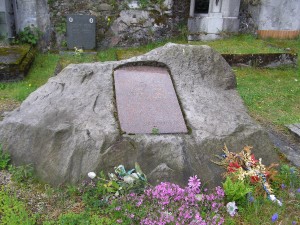
A simple stone memorial with a red marble plaque bearing the inscription was erected above the grave: “HERE FOUND THEIR FINAL REST / 4 SOVIET PRISONERS, / 1 POLISH SOLDIER / AND 1 UNKNOWN FROM A DEATH MARCH / AS VICTIMS OF NAZISM. / REST IN PEACE IN CZECH SOIL!” The ceremonial unveiling took place on 7 November 1948 on the occasion of the anniversary of the October Revolution. Representatives of the town, the army, district and regional authorities, delegations from schools and the scouting organisation, an honour guard of firefighters and clergy – a Catholic priest from Jáchymov and an Orthodox priest from Karlovy Vary – attended the ceremony.
It was later established that the previously unknown victim of the death march was of French nationality. However, his remains could not be released, as the vault had already been sealed and it was impossible to determine in which coffin he had been laid. Three of the four Soviet prisoners were identified: Filimon Černěnko, Berija Korostěnko and Petr Šumkin. The fourth Soviet prisoner, the Polish soldier and the French victim remain unnamed.
Description
The memorial was situated directly among other graves in the cemetery rather than as a separate honorary burial ground. Its original form was simple and reflected the period in which it was created. The stone memorial with the marble plaque stood above the brick vault and commemorated the shared fate of the victims of Nazism.
In 1955, on the occasion of the tenth anniversary of the end of the war, a new monumental marble memorial approximately 2.5 metres high, crowned with a red five-pointed star, was erected at the site. The original plaque was transferred to this monument. It was unveiled on 9 May 1955. From 1949 onwards, commemorative ceremonies marking the end of the Second World War were regularly held at the site.
Restoration
Following the political and social changes of the early 1990s, the considerably deteriorated marble monument was removed in 1991 and the site was restored to a more modest form closer to its original appearance. The place continues to commemorate the victims of the war without prominent ideological symbols, while preserving the memory of their tragic fate.


