CHAPEL OF SAINT PROKOP
The chapel dedicated to Saint Procopius was built on a secondary summit of Mount Stráž (840 m above sea level), locally called Klobouk. Its builder was the mining official Püchner, and therefore the chapel is referred to in some sources as the Püchner Chapel (Püchnerkapelle). The builder was probably also the founder of Püchner’s factory for smalt and cobalt pigments, established in 1780 near Lintacker’s silver smelter (later a factory for uranium colours and radium).
Construction apparently began during the reign of Emperor Joseph II, but the chapel was never completed. Several explanations are given for why the work stopped. According to one version, Emperor Joseph II himself forbade the completion during his visit to the town as part of his reforms. Another tradition claims that lightning frequently strikes the summit, making any building there problematic. A further explanation states that Püchner asked church authorities for permission to hold services in the chapel. The Church agreed, but only on condition that a larger financial sum be deposited for future maintenance. This allegedly angered the builder so much that he halted construction. At the same time, he is said to have cancelled an already approved procession from the Church of St Joachim to the Chapel of St Procopius, planned for the feast day of this patron saint of miners and of the Czech lands.
At the time the construction was interrupted or abandoned, the masonry had reached roughly the height of an adult man. The chapel is still shown on the Stable Cadastre map of 1842. In 1873, the surviving granite masonry was about one metre high. By 1913 only the base was still visible, and today virtually no remains can be found on the site.
The chapel was oriented to the east, and the nave had a slightly rectangular ground plan measuring approximately 4.7 × 4.4 metres. The chancel (presbytery) was about 1.3 metres deep and closed on three sides (three sides of an octagon).
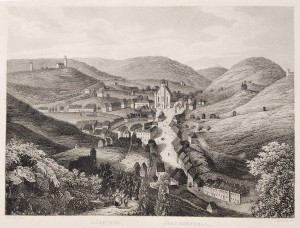
The only known depiction of the chapel appears on a steel engraving made in 1860 by Fesca after a design by W. Kandler. The chapel is shown on the far right at the top of the hill.