BAROQUE COLUMN OF THE HOLY TRINITY
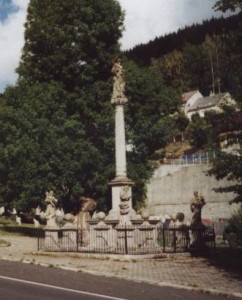
The Baroque column with a sculptural group of the Holy Trinity, complemented by statues of the Virgin Mary (Immaculata), Saint Joseph, Saint Anne and Saint Joachim, was erected in 1703 by the sculptor Zeidler from Ostrov. The monument stands near the Renaissance town hall on the open space in front of the main southern façade of the Dean’s Church of St Joachim in the upper part of Jáchymov. According to the town chronicle by Gregor Lindner, the work had already been completed in 1702 for 809 gulden and 43 kreuzer and was consecrated in 1703.
The ensemble rests on three granite steps. A tall prismatic stylobate supports a granite pedestal carrying a Corinthian granite column. The rather unusual crowning group of the Holy Trinity takes the form of the so-called Throne of Grace (Gnadenstuhl) carved from fine-grained sandstone. God the Father stands holding before him a crucifix with the half-figure of Christ, while below is the Holy Spirit depicted as a dove. Above the base of the column there was originally a metal plate with the heart-shaped shield of the newer town coat of arms granted in 1546 and carried by two miners. Beneath it was the inscription: “Zu Ehren der allerheiligsten Dreisaltigkeit hat die heilige löbliche Knappschaft diese Bildsäule errichten lassen im Jahre 1703.” (In honour of the Holy Trinity, the honourable miners’ guild had this column erected in 1703.)
On four granite corner pillars — remains of the original railing — stand the sandstone statues of the Virgin Mary (Immaculata), Saint Joseph, Saint Anne and Saint Joachim, also carved from fine-grained sandstone. These figures are unusually oriented all in the same direction. A similarly unusual arrangement can be seen on the Holy Trinity column in the square at Klášterec nad Ohří. On eight additional smaller pillars, two on each side, there are small sandstone bases topped with spheres. Between the pillars runs an ornamental Gothicising cast-iron railing with a gate.
The statues surrounding the column form the Holy Family. Originally this consisted of Jesus Christ, the Virgin Mary and Saint Joseph. Later, Saint Joachim and Saint Anne — the parents of Mary — were also included. This iconographic choice was not accidental, as the Holy Family is traditionally regarded as a patron of the mining regions of the Ore Mountains. The statues originally stood on the base of the column and were moved to their present positions during the 18th century.
Virgin Mary Immaculata – (Immaculata conceptio = the Immaculate Conception). She is depicted standing on a crescent moon with the tips turned upward. Patroness of Marienberg.
Saint Joachim – patron of Jáchymov.
Saint Anne – depicted with the young Mary. Protector of miners and patroness of Annaberg.
Saint Joseph – foster father of Jesus, depicted with the Child Jesus. Patron of Josephtal.
In a number of publications, the local depiction of the Virgin Mary is described as an Assumptio. I am, however, convinced that it clearly represents an Immaculata, and therefore the basic differences between these iconographic types are outlined below.
Immaculata – Mary stands on a crescent moon, usually with the tips turned downward (occasionally upward, or replaced by a globe symbolizing the world), and is surrounded by twelve stars. She is depicted as a young girl, about thirteen years old, with her hands folded in prayer on her chest, dressed in a white robe girded with a Franciscan cord with three knots and a blue mantle.
Assumptio (Assumption of the Virgin Mary) – depicted in prayer or with raised arms and gaze directed upward. She often stands on a crescent moon with the tips turned upward and is frequently surrounded by a radiant aureole symbolizing her heavenly dignity as Queen of Heaven (often together with a crown) or the vision of Emperor Augustus. This artistic theme was especially popular in the Late Gothic period, although the Assumption itself was proclaimed a dogma by the Catholic Church only in 1950.
Photo gallery: http://mipalfi.rajce.idnes.cz/Sloup_Nejsvetejsi_Trojice/#


