HANDSTEIN – A MINING WORK OF ART
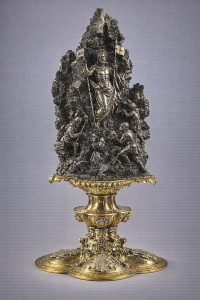
Handstein, Caspar Ulich, 1565
INTRODUCTION
The term handstein originates from German and refers to a mineral or piece of ore of distinctive appearance and high quality that could be lifted with one hand. The Latin term lapis manualis is merely a literal translation of the German expression. It did not denote an ordinary mineral, but rather a carefully selected specimen whose shape, structure or metal content made it suitable as the basis for an artistic object.
HISTORY AND DEVELOPMENT
Handsteins were most commonly made from silver or tin ore, later also from copper or polymetallic ores. The selected piece was subsequently worked by a goldsmith and complemented with figurative or architectural elements. The base was usually made of gilded silver or precious types of wood. The result was a unique combination of natural formation and artistic craftsmanship.
The earliest handsteins originate from Jáchymov, and their production is associated with Conz Welcz after 1520. Another prominent artist was Caspar Ulich, who worked in Jáchymov in the third quarter of the 16th century. It was within this flourishing mining town that a tradition emerged which later spread to other regions of Central Europe.
In the 18th century, the production of handsteins experienced a revival, for example in Příbram, Kremnica, Banská Bystrica and Banská Štiavnica. At the beginning of the 19th century, precious ores began to be partially replaced by other materials such as wood, moss, bark, tree resin, papier-mâché canvas or even paper. The handstein gradually transformed from a representative mining artefact into a decorative object.
DESCRIPTION AND TYPOLOGY
The early, or so-called Jáchymov handstein, consisted of a single piece of mineral that was partially worked and supplemented with small figures or objects. Most commonly, it depicted religious scenes or mining scenes with a spiritual dimension. Examples include Calvary scenes with the crucified or triumphant Christ, representations of Golgotha, the Garden of Gethsemane with the praying Christ, or the Way of the Cross. After the onset of the Reformation, motifs such as the Expulsion from Paradise, the Creation of Eve, or paired motifs on opposite sides of the handstein appeared, with one Old Testament and the other New Testament subject.
Accompanying figures often depict working miners with their equipment or characters thematically related to the main scene. There are also handsteins representing chapels, castles or mining veins. Their bases are frequently designed as goblet-like supports with a broad foot. A special category consisted of small handsteins worn as amulets.
Later handsteins, no longer originating from Jáchymov, are usually composed of several pieces of rock arranged horizontally. Some reached the size of a tabletop, though more commonly that of a large tray. In certain cases, the base is formed by bearer figures, such as miners carrying the handstein in their hands or even on their heads. These compositions depict models of real castles, the Nativity scene with the manger, towns or craft workshops, often complemented by druses of gemstone crystals. A special category includes handsteins with movable mechanisms, in which the accompanying figures perform characteristic activities.
SIGNIFICANCE AND FUNCTION
Handsteins were primarily displayed in aristocratic cabinets of curiosities as representative objects combining the wealth of nature with human artistry. They became symbols of mining enterprise, technical skill and the religious worldview of their time.


